
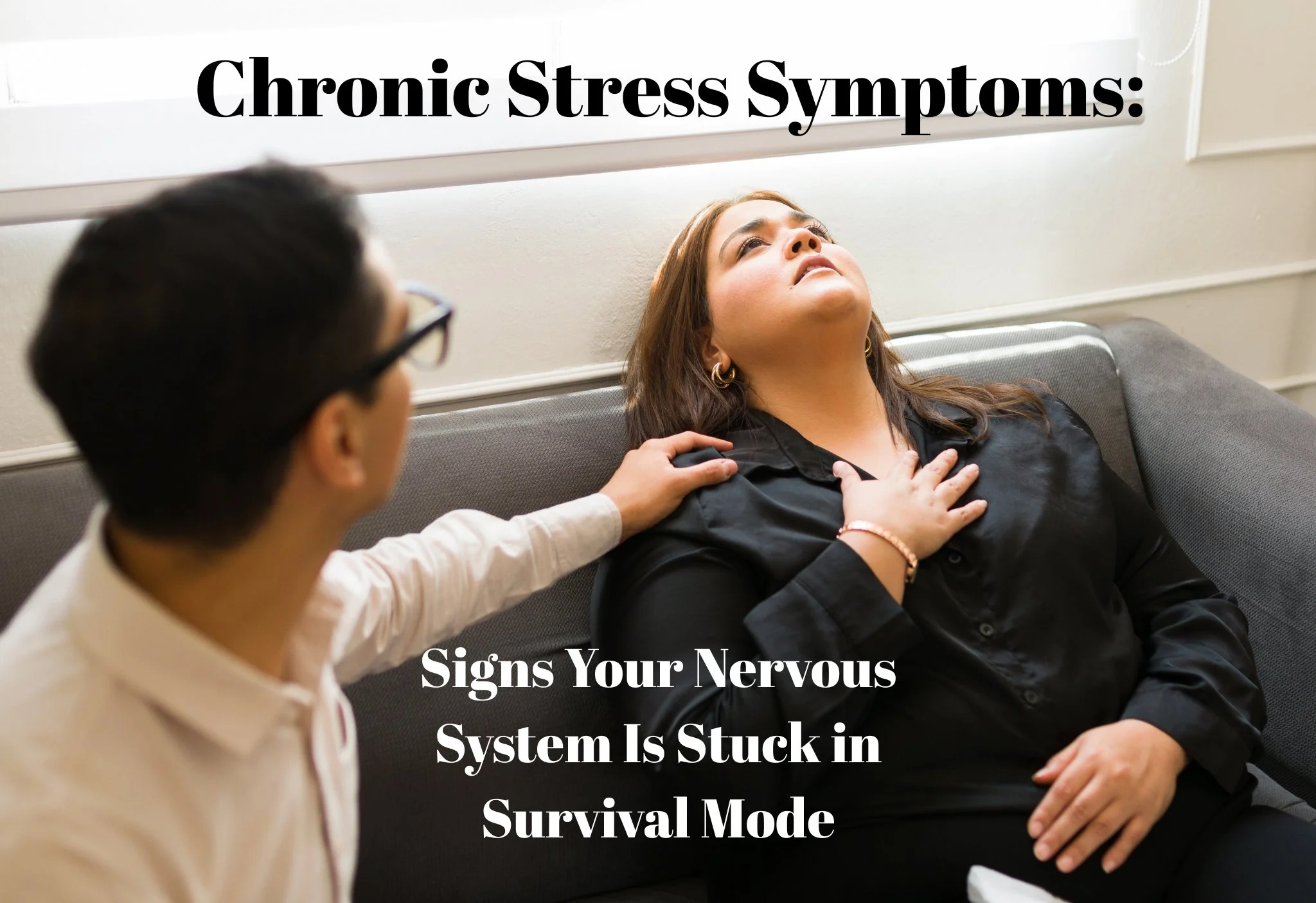
Most people think the fight-or-flight response feels like panic.
Heart racing. Shortness of breath. Out of control.
That’s full-blown anxiety attack.
But that’s not how the fight or flight response usually shows up.
Most of the time, it’s quieter than that.
More subtle.
It’s…your every day life.
So normal that you don’t question it.
You just think:
“This is how I am. I’m a type A personality.”
Or maybe it’s the way you learned how to survive.
What Is the Fight-or-Flight Response?
The fight-or-flight response (AKA the Sympathetic Nervous System) is your body’s natural survival system.
It’s designed to activate when something feels threatening…
Help you respond…
Then shut off once the danger is gone.
But for many people, it doesn’t shut off.
Instead, the nervous system stays activated—keeping the body in a constant state of stress.
This is often referred to as a dysregulated nervous system or being stuck in fight or flight.
Signs Your Body Is Stuck in Fight or Flight
When your nervous system is constantly activated, it impacts your body, mind, emotions, and behavior.
Here are the most common symptoms:
Physical symptoms of fight or flight
Tight chest or shallow breathing
Constant muscle tension (especially shoulders, jaw, neck)
Headaches or migraines
Digestive issues (bloating, constipation, IBS-like symptoms)
Fatigue but wired at the same time
Trouble falling asleep or staying asleep
Heart racing or increased heart rate
Sweating more than usual
Getting sick more often (weakened immune response)
Mental symptoms of chronic stress
Racing thoughts you can’t shut off
Overthinking everything
Difficulty focusing or making decisions
Brain fog
Always scanning for what could go wrong
Feeling overwhelmed by small tasks
Emotional symptoms of nervous system dysregulation
Irritability or snapping quickly
Anxiety that feels constant or baseline
Feeling on edge for no clear reason
Low frustration tolerance
Emotional reactivity (big reactions to small things)
Difficulty feeling calm, even when things are “fine”
Behavioral signs you’re stuck in survival mode
Always busy, can’t sit still
Avoidance or procrastination (because everything feels like too much)
People-pleasing or over-functioning
Needing control to feel safe
Trouble relaxing or “doing nothing”
Reaching for coping habits (scrolling, food, alcohol, etc.)
The Most Overlooked Symptom
The biggest sign your body is stuck in fight or flight?
You don’t feel safe slowing down.
Stillness feels uncomfortable.
Rest feels unproductive.
Silence feels… loud.
So you keep moving.
Keep thinking.
Keep filling the space.
Not because you want to—
but because your body doesn’t know how to stop.
Why This Happens
The fight-or-flight response is meant to be temporary.
But chronic stress, unresolved emotions, and constant stimulation can train the body to stay in that state.
Over time, your system adapts.
High alert becomes your baseline.
And from there:
Your breathing changes
Your muscles stay tight
Your mind stays active
Your body keeps scanning for danger
This isn’t a lack of discipline.
It’s a nervous system pattern.
You Can’t Think Your Way Out of This
This isn’t just a mindset issue.
Because the stress response doesn’t start in your thoughts.
It starts in your body.
Trying to “think positive” or push through it often makes it worse—
because your body still feels unsafe.
How to Get Out of Fight or Flight
To shift out of survival mode, your body has to experience safety again.
That doesn’t come from forcing yourself to relax.
It comes from creating signals that tell your nervous system:
“There is no threat right now.”
This is where practices like breathwork, somatic awareness, and nervous system regulation come in.
Simple things like:
Slowing your breath
Orienting to your space
Bringing awareness into your body
Noticing your feet
These begin to retrain your system over time.
Final Thoughts
If you see yourself in this, your body has likely been trying to protect you for a long time.
But you don’t have to stay stuck there.
Your nervous system can learn a new pattern—
one where you can respond to stress when needed…
and come back to calm when it’s over.
If you would like to learn more or learn how to integrate these skills in your life, email me at steph@risingphoenixbreathwork.com or schedule a one on one appointment.